| Home | Nature Weekly Index |
9 August 2026 | Dwarf Voodoo Lily | Typhonium roxburghii |
In June, while checking the status of Gymnanthemum amygdalinum (South African Leaf) in Singapore, I came across a Root Awaking article featuring a photograph of Typhonium roxburghii (Dwarf Voodoo Lily). After comparing it with images on my website, I realised that I had mixed photos of Typhonium roxburghii with those of Typhonium trilobatum (Bengal Arum). I have since moved the Typhonium roxburghii images to a separate species page.
The Typhonium trilobatum images shown on NParks’ Flora & Fauna Web, viewed on 9 August 2026, likely depict Typhonium roxburghii instead. Typhonium roxburghii is not listed on that website.
On iNaturalist, accessed on 9 August 2026, there were 8 Singapore observations of Typhonium roxburghii and 13 of Typhonium trilobatum. Of these, only one included detailed images of the inflorescence. I learnt that, without examining such details, it is almost impossible to distinguish the two species accurately [1].
In addition to these two Typhonium species, the 2022 Singapore Flora checklist lists a third species, Typhonium flagelliforme. However, iNaturalist has no Singapore observations of this species.
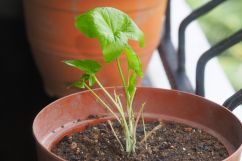
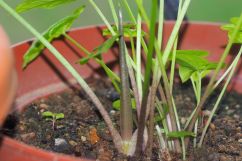
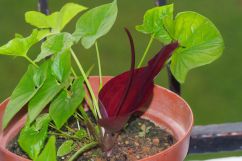
Although I grew Typhonium roxburghii in a pot between 2004 and 2008, I did not examine its full inflorescence in detail at the time, especially the basal region hidden within the spathe. I no longer keep this species in a pot, but I know of a population growing on a grass patch below my apartment block, where it has persisted for many years. I have never seen it flower, probably because the grass is trimmed regularly. To confirm its identity, I collected a specimen in late June (Fig. 1) and nurtured it until it produced an inflorescence. Unexpectedly, the first flower bud appeared about a month later, on 26 July (Fig. 2); I initially mistook it for a young emerging leaf. The bloom opened on 1 August (Fig. 3). As I did not know how long it would last, I removed it that day to study and photograph its details (Fig. 4). The features of the male flower zone confirmed that the species is Typhonium roxburghii. A 2024 article on Typhonium species in Myanmar includes a useful coloured illustration comparing the inflorescences of several species, including Typhonium roxburghii, Typhonium trilobatum and Typhonium flagelliforme [2].
 |
 |
 |
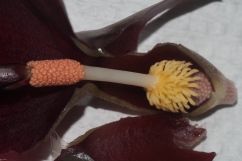 |
| Fig. 1: Specimen collected in late June | Fig. 2: Flower bud appeared in late July | Fig. 3: Inflorescence bloom on 1 August | Fig. 4: Male and female parts of the inflorescence |
For Typhonium trilobatum, I recently obtained a suspected specimen with deeply tri-lobed leaves from a different location, several apartment blocks from where I collected the Typhonium roxburghii specimen. I will update its status once the inflorescence appears.
References:
[1] Nicolson DH, Sivadasan M. Four frequently confused species of Typhonium Schott (Araceae). Blumea 1981;27:483-497. | Read article |
[2] Hein KZ, Saensouk S, Naïve MAK. Taxonomic studies of Araceae in Myanmar VIII: Two new species and three new records for the genus Typhonium. Taiwania 2024;69(4):537-544. | Read article |